Friday, October 23, 2026

The Calamity Club

The Calamity ClubThe Calamity Club by Kathryn Stockett
My rating: 2 of 5 stars

Kathryn Stockett is a great writer. She can write humor, create memorable characters, and hide history in a great story. Still, there is enough implausibility in this story to make it more of a tall-tale than historical fiction. Which I would be ok with if it didn't dress itself up to be pro-feminist when rather it undermines women in lots of ways. The villain is a woman who is portrayed as evil and vindictive despite her disappointments and betrayals. The answer to the main problem is (view spoiler) Also, the build up to the main story is slow and simmering and then it rushes at the end and doesn't resolve some of the main conflicts (view spoiler) I liked the era: I liked Birdie; I liked the exploration of different types of childlessness; I liked the humor. Meg was adorable even if her story seemed to be a little drawn out and arbitrary for her part she played. I wish I liked it more than I did.

View all my reviews

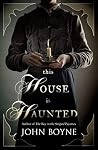
This House is Haunted


This House Is HauntedThis House Is Haunted by John Boyne
My rating: 5 of 5 stars

Is this the most amazing book? No, but it accomplishes exactly what it sets out to do which is to have a nanny take a job in a haunted house written in Dickens time and language. Is it plausible? (maybe not). Is it is atmospheric with creepy children and unexplainable phenomena? (definitely yes). Do we have a brave heroine full of quiet strength? (Yes, as much as is permissible in this era). Very enjoyable!

View all my reviews

The Interestings


The InterestingsThe Interestings by Meg Wolitzer
My rating: 4 of 5 stars

This is trite, I know, but this book was very interesting. A group of campers who name themselves The Interestings become life long friends and we follow them backwards and forward in time through all the vicissitudes of life. One becomes a famous artist (albeit a comic artist), one marries him and becomes a theater director, one has to lay aside her artistic aspirations to make money, and another shuns his gifts because of trauma. Underlying it all is the secret of the most charismatic member who disappears after he is accused of a horrible crime. The novel touches on a lot of different subjects: coming out, depression, autism, generational wealth but its main focus is loyalty. Who do we become loyal to and why? What is true loyalty? What does betrayal look like? Who do we envy and why? Wolitzer seems to point out that everyone has their trials regardless of talent or money but good friends can help us through it.

View all my reviews

But maybe in life, she thought later, there are not only moments of strangeness but moments of knowledge, which don't appear at the time as knowledge at all.

he seemed to be watching it all in third person, neither approving nor disapproving, and unable to affect the outcome.

He felt grateful to have decisions taken away from him for once, and to know he would not be overcome with feeling in ways that were always hard for him to manage.

The Night Manager


The Night ManagerThe Night Manager by John le Carré
My rating: 3 of 5 stars

It's le Carré, so I'm obligated to like it. But, dare I say, I liked the TV version better? (first season only).

View all my reviews

Shadow meaning identity.  Shadow meaning substance, in a world where Jonathan had become a ghost.

Guns have their own silence.  It is the silence of the dead to come.

A Suitable Boy


A Suitable Boy (A Bridge of Leaves, #1)A Suitable Boy by Vikram Seth
My rating: 4 of 5 stars

This was like an Indian War and Peace . Spanning a large cast of characters, with Lata at the center, we follow the early years of India's independence and Partition of Inida and Pakistan. I learned so much about India's history while being very vested in who Lata would choose to marry: the Muslim boy she meets at school and has an immediate and intense connection with; the boy whom her mother has chosen who is in the same caste as they are, is ambitious and works in a shoe factory; or the brother of one of her sister-in-laws who comes from a slightly higher caste and is a well-know poet and aspiring novelist. Amongst this dilemma Seth interweaves the politics of Muslim and Hindu relations, both politically and religiously, describing house debates and various religious observances. Music, poetry, drama, and gardens are a large part of these lives. Also, surprisingly, a lot of talk about shoe making.... But also purdah, caste, and the role of the different languages are explored. There is love, passion, bromance, riots, attempted murder, garden parties, weddings, well, it's long enough to cover about everything. Despite its length, not everything is tied up, but the major questions are answered, even if it's not quite what I wished. Although it took me most of the summer to read it, I thoroughly enjoyed it.

View all my reviews

"What I meant was that you're in a completely different element.  All your movements are different--and, as a result, all your thoughts..."

He did not understand her but he was not understanding.

"They say he takes Rama's name all day.  Why does he do so?"
"Wood burns when rubbed and rubbed till it gives you the light you desire."

When she wanted a handyman, she seized upon any man who was handy.

What, she asked herself, had happened in one generation that of her three children, only one continued to believe in what their forefathers had believed for hundreds, indeed thousands, of years?

Sooner or later, what does not bend will snap.

The Librarians


The LibrariansThe Librarians by Sherry Thomas
My rating: 3 of 5 stars

A fun mystery, with an eclectic set of characters set in Austin. The library as a setting was interesting, but not necessarily pivotal to the action. Not particularly outstanding in any way, it wasn't bad either. Just a fun summer read.

View all my reviews

When someone is nice to you for no apparent reason, they either want sex or money.  Whoever first quipped so had probably never met missionaries, but in general the rule holds.

Wednesday, September 2, 2026

Angle of Repose

Angle of ReposeAngle of Repose by Wallace Stegner
My rating: 5 of 5 stars

I first read this in college, before I got married, and right before I dated a cowboy (perhaps not coincidentally). It wasn't quite the novel I remember, the ending climax so shocking to me then it seemed to be the center of the book and I would have told you it was solely about that one incident. It is, as Lyman Ward, the fictitious narrator, put it, a history of a marriage. It is how Susan Ward followed her engineering husband into the "wild" west and tried to keep a hold on who she was and where she came from. It is how a man tries to keep his integrity in a lawless land. It is about the sacrifices they make to keep their family together, and the dreams they have both individually and together. The memorable tragedy of the novel could be laid at the foot of Susan, of her pride and her selfishness and her longing for something more than the life her husband offered her. But Lyman is more compassionate toward her than he is his own wife, and through his eyes we see someone desperately trying to make peace with the life she led rather than the life she dreamed about. ("Is this the life you chose yourself/Or just how it ended up?" The Killers). The fact that Susan and Oliver end up in an "angle of repose", a place of "lying down", a place of acceptance or appeasement, which for them was a "separate line that did not intersect", is perhaps the true tragedy.

I wondered back then why Stegner used Lyman Ward particularly as the narrator/ historian. The intro in my copy says it was a way to embody the idea of time being lived in the past and present simultaneously that occurs when working on historical works. I think, too, having Lyman Ward be as helpless as he was allows him to understand the confinement, dependence, and desperation Susan, as a woman had, especially in that era.

Having read this novel again after being married for 30+ years, I find it even more intricate and nuanced than I did the first time around. Our marriage also included several moves, several dreams that changed, several sacrifices and choices for our family. I am gratified that our angle of repose seems to be rolling closer together, but can relate to some of the feelings and frustrations of Susan and feel the full effects of the tragedy must have been for Susan after having children of my own ((both the loss of one, and the loss of the respect from the other)). Stegner writes these emotions as beautifully as he describes the west--both its beauty and its barrenness. His landscapes are the perfect backdrop for this marriage that struggles to survive in the elements, each not quite comprehending what the other needs.

View all my reviews

I believe in Time, as they did, and in the life chronological rather than in life existential. We live in time and through it, we build our huts in its ruins, or used to , and we cannot afford all these abandonings.

the Doppler Effect. The sound of anything coming at you--a train, say, or the future--has a higher pitch than the sound of the same thing going away.

who wants to compute the speed of history? Like all falling bodies, it constantly accelerates. 

But I would like to hear your life as you heard it, coming at you, instead of hearing it as I do, a sober sound of expectations reduced, desires blunted, hoped deferred or abandoned, chances lost, defeats accepted, griefs borne. 

Exposure followed by sanctuary was somehow part of Grandmother's emotional need, and it turned out to be the pattern of her life.

Don't you know how we lose the sense of your own individuality when there is nothing to reflect it back upon us?

What really interests me is how tow such unlike particles clung together, and under what strains, rolling downhill into their future until they reached the angle of repose where I knew them.  That's where the interest is.  That's where the meaning will be if I find any. 

What made that union of opposites home them?

It was what she had deliberately chosen.

Something must have told her, as they dragged over the summit and down to English George's that character as well as mountains had to strip for the skies.

For that sort of pioneer, the West was not a new country being created, but an old one being reproduced.

Quiet desperation is another name for the human condition.

I only know that passion and guilt happened, in some form.  In their world, their time, their circumstances, and given their respective characters, there could have been no passion without guilt, no kisses without tears, no embrace without despair.

He had to be himself--nothing spectacular, nothing gorgeous or picturesque.  Just, as she had more than once said in her letters to Augusta, her plain boy.  But it was on his sill and judgement that everything hung.  Having doubted him thought the picturesque hour of departure, she no saw him go with a quick, strong rush of love and pride.

Is it not queer, and both desolating and comforting, how, with all associations broken, one forms new ones, as a broken bone thickens in healing.

She mined and irrigated every slightest incident, she wrote and drew her life instead of living it.

"You married me," his look said. "Maybe that was a mistake.  But you didn't marry what you could make out of me.  I wouldn't be much good remodeled."