Saturday, November 26, 2022

The Waves

The WavesThe Waves by Virginia Woolf
My rating: 5 of 5 stars

A beautiful contemplation of life told through the soliloquies of four friends as they go through life from primary school to old age. Or are they four facets of the same person? Eddies of poetry wash over narration of life so that the two are mixed together, revealing that our perceptions are partly what we dream, fantasize, and fear. I could read again and again, plucking out sentences to muse over indefinitely .

View all my reviews

My Brilliant Friend

My Brilliant Friend (The Neapolitan Novels, #1)My Brilliant Friend by Elena Ferrante
My rating: 5 of 5 stars

This is a novel of effortless writing. Each time I was sucked into the life of Lila and Lenu and was never distracted by the narrative--their world just simply came alive. A story of young girls and the love/hate/admiration/envy convergence that is friendship. Money is always in the background, and education becomes paramount--until the prospect of marriage appears. This is a series I am eager to continue.

View all my reviews

Monday, November 14, 2022

All the Bright Places


All the Bright PlacesAll the Bright Places by Jennifer Niven
My rating: 4 of 5 stars

Very realistic characters dealing with some heavy things. Violet deals with depression brought on by grief, while Finch seems to be dealing with some chemical/mental issue--more of a bipolar thing. While Finch is able to help Violet realize that life is worth living, Finch needs some more intense help. While this did a great job exploring these issues, I wouldn't know if this book would be helpful or triggering for teens dealing with the same sort of thing. It also really made me want to visit Indiana.

View all my reviews

Wednesday, November 2, 2022

Psychology of Robbe Grillet's Writing in Jealousy


    Critics of Robbe Grillet point out that his mode of storytelling fixates on the listing of things seen, in an objective, non-allegorical, “definitive interrogation of the object”.  Barthe describes his Grillet's style as “man’s direct experience of what surrounds him without his being able to shield himself with a psychology, a metaphysic, or a psychoanalytic method in his combat with the objective world he discovers”.  Bruce Morrisette explained that there was an “absence of any psychological analysis”, “a rejection of introspection, interior monologues or thoughts”.  While this is true in the strictest sense, Grillet does a marvelous job of positioning the reader behind the narrator’s eyes. By explaining what the narrator is looking at, whether in real time or in memory, Grillet allows the reader to fill in any blanks psychologically for the character.  As the reader looks at what the narrator looks at, he can’t help himself but ask why is the narrator looking at that? What is the purpose of describing that object? Is what the narrator describing even real? By answering the questions that are raised, the reader is able to deduce the thoughts, actions, and emotional state of the narrator.  

For example, the narrator starts out by describing his house and the movements of A (presumably his wife).  She has something in her hands, but the narrator isn’t sure what it is but infers that it is “probably…a sheet of paper”.  He is only able to surmise that it is probably a sheet of paper because he notices a sheet of paper later in the narration that gives him suspicion.  So we can tell that this narration is not “Now” as is indicated in the beginning paragraph, but a recreation in his memory.  

Later having drinks with Franck, the neighbor, A... leans over to listen to Franck, but the narrator can’t distinguish what is said and decides that Franck is “probably thanking her”.  It is as if the narrator is simply trying to come up with the most plausible, most benign exchange he can think of.   There are a number of instances where the narrator is clearly trying to rebuild scenes, thinking through details which might give him clues about…something.  “Memory succeeds…in reconstituting several movements of her right hand and her lips…which might be considered significant…which, on reflection, does not prove beyond a doubt that she tasted the soup today.  Now the boy clears away the plates.  It then becomes impossible to check again the stain in A…’s plate--or their absence, if she has not served herself.”  

This passage not only points out the inconsistencies and ambiguities of memory, but also brings up the motif of stains that are presented throughout the story. There are some marks left on a sheet of writing paper, oil stains left by Franck’s car, even the glow of Franck's shirt in the dying light of dusk standing out against the dark wall, but of primary interest is the stain left by a centipede Franck smashed on the wall one night at dinner.  The details of this incident is told over and over in detail, although it happened “at the beginning of the month, perhaps the month before, or later.”  Each time the incident is recalled, more incriminating evidence is revealed.  The first time, the narrator says “A…seems to be breathing a little faster, but this may be an illusion.  Her left hand gradually closes over her knife…The hand with the tapering fingers has clenched around the knife handle”.  Another time, he amends “The hand with the tapering fingers has clenched into a fist on the white cloth.”  Then, “The hand with tapering fingers has clenched into a fist on the white cloth.  The five widespaced fingers have closed over the palm with such force that they have pulled the cloth with them”, the creases of which spread out until they touch Franck’s hand where he rests it next to a “knife blade [which] has left on the cloth a tiny, dark, elongated, sinuous stain surround by more tenuous marks” before Franck's hand rises to push down a suspicious letter in his shirt pocket.  Finally, the incident is recalled in a different setting altogether, being in the bedroom not the dining room: “he comes back toward the bed…The hand with the tapering fingers has clenched into a fist on the white sheet.  The five widespread fingers have drawn the cloth with them…” The narrator may only be describing what he remembers, but it clear that his memory reflects his psychology: the incident of the centipede killing goes from incidental to incriminating.

Even the description of the stain reveals the narrator’s state of mind:  “the outline seems indelible.  It has no relief, none of the thickness of a dried stain which would come off if scratched at with a fingernail.  It looks more like brown ink impregnating the surface layer of the paint.”  “It has no relief” describes the nature of stain but also reflects the attitude of the narrator: he, too, has no relief from the thoughts that keep running through his mind.  The ink “impregnating” the surface once again reveals that the narrator feels there is something sexual going on.  

 The killing of the centipede becomes the focus of the narrator, but its precise significance eludes us.  Is the centipede the affair, the stain on an otherwise serviceable relationship?  Or is the centipede the narrator, causing consternation in A and quickly dispatched without mercy by Franck?  Or does the killing of the centipede symbolize the way Franck can meet the needs of A, swift and sure, while the narrator simply sits and watches?  Each reader, perhaps, gives a different interpretation and hence the story's meaning and impact changes with each reader.

As significant as the descriptions of these stains are in the story, the efforts the narrator goes through to eradicate them is just as telling.  Some stains are simple to erase, just adjusting the angle of perspective--“It is easy to make this spot disappear thanks to the flaws in the rough window”, while others require real effort, such as the removal of the centipede stain that requires an eraser and a razor: “There now remains only a vaguely outlined paler area, without any apparent depression of the surface, which might pass for an insignificant defect in the finish, at worst.”  One can’t help but wonder if the narrator is thinking of using some sort of tool to extirpate the interloper in his marriage.  “The precision for the tool permits the area exposed to its effect to be carefully determined.”   How can the narrator remove these thoughts, the apparent treachery and all that it entails, and restore his relationship to what it was before, to make this all “insignificant”, “without any apparent depression”?  At one point the narrator describes a car crash with Franck inside, the “car immediately bursts into flames…It is the sound the centipede makes”.  This “observation”, another memory that is apparently only imagined, is probably one of the closest clues we get to the true feelings of the narrator. 

Interestingly, it is not the centipede stain that is so hard to erase but marks left on the blue paper.  This is tangible evidence that she has written to Franck something secret, something that she has not shared with the narrator, that she has orchestrated a miscommunication with the servant to maneuver the narrator out of the room so she could deliver it to Franck, and that Franck then tried to hide in his shirt pocket.  It is this interchange more than any other that causes the narrator to then rethink all that has gone before and after.  The remaining evidence, the “two short pen strokes” appear to resist both the eraser and the razor, “doubtless because they were made too heavily.  Unless a new word, skillfully arranged to cover up these two unnecessary strokes, replaces the old one on the page, the traces of black ink will still be visible there.”  What is that new word?  What will replace the suspicion, jealousy, and uncertainty? 

Another way that the author allows us to glimpse inside the thoughts of the narrator is to follow his observations.  As he waits for his wife to come home that fateful night when she and Franck had “car trouble” and had to spend the night, the narrator reflects more on the sounds of things around him, the insects and animals “shrill and short”, the kerosene lamp “it’s sound  plainative, high pitched, somewhat nasal”, and most tellingly, the sound of trucks that rumble by : “it is moving just as fast as the preceding one, which for a moment might cause it to be confused with a touring car…”  All the while the narrator observes that “A…should have been back long since” and reasons they might be delayed from “engine trouble” to “driver’s fatigue”.  As the reader reads the descriptions of all these sounds, he can feel the how intently the narrator is listening for his wife’s return, his anxiety as he waits in vain. 

As the night progresses, the description turns to A’s bedroom and the content of her drawers, as though the narrator is looking for something, some evidence perhaps of the infidelity he imagines when “the light suddenly goes out”.  In the absence of the light, the abrupt cessation of the kerosene’s hissing, the narrator seems overcome by the darkness and silence: “the faintest movements become impracticable”.  Even his ability to measure, or describe becomes hindered in the “total darkness”.  Not only can the reader discern the apparent depression and despair of the narrator in that moment, but the reader can also see that the incessant descriptions, of the rows of banana trees in the plantation, the shadow length of the columns, the explication of insect behavior, all of it is a means of distraction for the narrator as he attempts not to see what he thinks he sees:  his wife falling in love with another man. 

Grillot’s style does more than experiment with the style of narration.  The entire act of taking reflection, motivation, even the ubiquitous “I” from the story reveals the feeling of powerlessness the narrator has about what is happening.  He is reduced to simply a bystander, peering through the blinds as it were, grasping at memories and trying to piece together the story from snippets of conversations and moments of observations.  He is like the workmen in the plantation surrounding the termite-ridden logs, looking at the problem from all the angles, and yet remaining motionless.  Are his observations true?  What was it that he did see?  What does all of it mean?  He constantly questions himself--”it may…be false, entirely made up,...or even imaginary”.  

Grillet has not removed psychology from his story, rather he has left the precise motivations, anxieties, and conclusions up to the reader to puzzle out using the narrator’s account to provide the clues.  Using vocabulary, time shifting, and motifs the reader is able to not only deduce what happened but what the narrator’s feelings are, and empathize with him as if the reader were the narrator himself, inside his brain, re-living all of the true, false, imaginary observations.  Grillet does not tell us the psychology of his narrator, he allows the reader to live it with him.


Monday, October 31, 2022

MaddAdam


MaddAddam (MaddAddam, #3)MaddAddam by Margaret Atwood
My rating: 3 of 5 stars

Atwood has some searing insights into American disfunction especially when it comes to environment, sexual exploitation, drug use, and a society dictated by social media feeds. The abuse of science is front and center, with the juxtaposition of a religious cult that is not only just intellectual as the corporate scientists but whose faith helps them survive a man-made pandemic. Yet for a dystopian trilogy, the pacing is off. There are lots of interesting flashbacks, this book focused on Zeb, the "fixer" of the cult and Adam One's brother. Those are interesting, but when it comes to the action scenes, in the whole trilogy, and especially this one, there is a let-down, not a build up. And the monumental moments are told in profoundly uninteresting ways. This book, in particular, seems more of a denouement than finale. Many of the characters we got to know in Books 1 and 2 have bit parts to play here (Jimmy and Amanda and Ren) and even Toby and Zeb's relationship feels more inevitable than satisfying. Some (most) of Zeb's adventures have the feeling of myth instead of truth and makes what happens next even harder to fathom.

View all my reviews

Friday, October 21, 2022

Another Man's War


Another Man's War: The Story of a Burma Boy in Britain's Forgotten African ArmyAnother Man's War: The Story of a Burma Boy in Britain's Forgotten African Army by Barnaby Phillips
My rating: 5 of 5 stars

A typical conceit of non-fiction writers is to use one or a few typical narratives to illustrate a more global phenomenon, and that could be seen as the device Phillips uses here: the experiences of Isaac Fadoyebo, a Nigerian recruited by the British to fight the Japanese in Burma in WWII, to explore the issues and conflicts from that part of the War and what has occurred since then in those areas.
Indeed, colonialism, race relations and the history of Nigeria and Burma (Myanmar), are all discussed here but Issac's story and the story of the author attempting to find and reunite the players in this drama are transcendent. This is an incredible story--very inspiring--eye-opening--heart-warming. One of the best books I've read this year.

View all my reviews

Friday, October 14, 2022

Pale Fire

Pale FirePale Fire by Vladimir Nabokov
My rating: 4 of 5 stars

An interesting premise: a 999-line 4part Canto explicated by a fellow professor. Within the novel are at least 3 main stories--the story of Shade in form of the Canto; the story of Kinbote the fellow professor; and the story of an exiled king of Zembla and a would be regicide by Gradus. The poem is beautiful--I loved it just as is. The explication stories are amusing but a little plodding. I know there are schools of thought about what is true, who actually existed, etc. But I suppose I would have to be in a discussion group to really get involved in all that. As is, its an interesting presentation and an entertaining read.

View all my reviews

The sun is a thief; she lures the sea and robs it.  The moon is a their: he steals his silvery light from the sun.  The sea is a thief:  it dissolves the moon. 

Wednesday, October 12, 2022

The Year of the Flood

The Year of the Flood (MaddAddam, #2)The Year of the Flood by Margaret Atwood
My rating: 4 of 5 stars

The apocalypse (both pre- and post-) that was portrayed in Oryx and Crake is reiterated here, only following the stories of two members of The Gardners, a religious group that has separated themselves from society. They are part environmentalists, part survivalists, and part supplicant. Atwood treats these believers with more respect and compassion than I thought she would after The Handmaid's Tale and indeed many of The Gardners survive the plague partly because they are prepared for it. Characters from the first book make cameos and in the end, the two timelines converge. Atwood creates a rich world with multiple ways to react to the problems in society. This novel is slightly more hopeful than the last, but Atwood definitely is not optimistic for the future.

View all my reviews

Something in the Water

Something in the WaterSomething in the Water by Catherine Steadman
My rating: 4 of 5 stars

A pretty great thriller to read at the beach. Honeymooners find a bag in the water that will change their lives. Erin is the protagonist and the first-person, present-tense narrator. Her every thought seems to be recorded, which makes for several should I? shouldn't I? debates, with her usually deciding on the crazier of the two choices. But she is consistent in that way, and it makes for a fun ride. If it all comes out with a bow on it, it may not be realistic, but do we really care?

View all my reviews

Jealousy


JealousyJealousy by Alain Robbe-Grillet
My rating: 5 of 5 stars

I'll admit I had to read this twice to understand what Robbe-Grillet was doing, but once it clicked, I thought it was brilliant. Rather than describing in either first-person or omniscient narration what the character is feeling, Grillet puts you in the drivers seat. His narrator simply describes what he sees and hears with seeming technological precision. But when you see the temporal leaps, notice the differences in scenes described repetitively, notice adjectives used and recurring themes, you fill in the psychological questions yourself and become as intimately involved as if you were the character yourself.

View all my reviews

Midnight at Chernobyl


Midnight at ChernobylMidnight at Chernobyl by Adam Higginbotham
My rating: 5 of 5 stars

Other than understanding only the basic rudimentary facts about nuclear power and only knowing that the Chernobyl was a nuclear disaster, I was delighted that this book made both subjects infinitely more understandable and entirely engaging. Not only was Higginbotham able to clearly and succinctly describe how a nuclear power plant works and what went wrong at Chernobyl but he was able to describe the events leading up to the disaster, what happened immediately after, and the long-term implications with gravitas but also with heart-stopping, page-turning, mouth-opening thrill. If you want real-life detective stories, fast-paced political thriller, or even science-fiction wonder this non-fiction work is for you.

View all my reviews

Deprived of information about why such rules might be important, the operators went on with their work as usual, ignorant of the potentially catastrophic consequences of breaching them.

The Soviet nuclear industry, lacking even rudimentary safety practices, had relied upon its operators to behave with robotic precision night after night, despite constant pressure to bead deadlines and "exceed the plan" that made disregard for the letter of the regulations almost inevitable.

Friday, September 30, 2022

Oryx and Crake

Oryx and Crake (MaddAddam, #1)Oryx and Crake by Margaret Atwood
My rating: 4 of 5 stars

Atwood is best known for her The Handmaid's Tale, and this first book in the MadAddam trilogy, also deals with a post-apocalyptic scenario. Only this time science has prevailed (horrifically). It is full of corporate greed, economic stratification, scientific manipulations of everything from food to butterflies, and humanity's basest thoughts and actions proliferate unchecked. It is full of cynicism, yet Atwood's observations, as usual, are unnervingly on point. It is enough to depress you, and yet her bumbling, pathetic main character squeezes enough sympathy out of the reader to keep you interested to see what happens next.

View all my reviews

On having children:

"...human beings hope they can stick their souls into someone else, some new version of themselves, and live forever."
"As a species we're doomed by hope, then?"

The Beantown Girls


The Beantown GirlsThe Beantown Girls by Jane Healey
My rating: 4 of 5 stars

Three girls from Boston volunteer with the Red Cross to serve doughnuts and coffee to American troops in Europe during WWII. Like the doughnuts they serve it is sweet, unsubstantial, and seemingly unnecessary. But although this novel is heavy on the romance and fashion and light on the angst and horrors of war, it will make you question the necessity of something as slight as a doughnut truck in the time of war. These girls gave the boys a reminder of what they were doing out there in the first place and gave them a reprieve from the brutality of it all. Perhaps this novel doesn't communicate how really harrowing it was on the front lines, or the depravities endured, but it communicates a bit of pleasure and hope, which is what these girls were really offering. It makes you wonder if we couldn't use a bit of frivolous doughnut trucks in the midst of calamities today.

View all my reviews

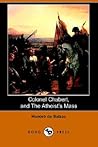
Colonel Chabert


Colonel Chabert / Atheist's MassColonel Chabert / Atheist's Mass by Honoré de Balzac
My rating: 4 of 5 stars

What if you were pronounced dead but didn't really die? Balzac reveals once again the depths of human greed and the lengths that one will go for love. Money is the measure of these emotions in Balzac's world, but he also reveals how the Law (or the Word) can define a person's life. If you are legally dead, it doesn't matter much if you are breathing, you aren't able to claim anything--your wife, your money, your experiences, even your name. It's a short read, but Balzac captures so much with so little.

View all my reviews

Moral suffering, before which physical suffering pales, never less excites less pity, because it is not seen. 

Tuesday, September 13, 2022

The Bookseller of Florence

The Bookseller of Florence: The Story of the Manuscripts That Illuminated the RenaissanceThe Bookseller of Florence: The Story of the Manuscripts That Illuminated the Renaissance by Ross King
My rating: 4 of 5 stars

Although a little too detailed at times, this was a great insight into the Renaissance. The looking for and discovery of ancient texts, and the details of copying them into books that were more like works of art. As this search for wisdom continued, the printing press was also starting to spring up in Europe, making the distribution of everything from Bibles to political pamphlets more prolific. Printing presses came with their own set of skills and investments, however, and this book explores that as well. In the center of it all, King focuses on an uneducated Italian youth, Vespasiano, who became a procurer of books for the renown names in Florence. Also interwoven is the history and politics of Florence and Italy and the prominent players of that era from Medici to Leonardo da Vinci. It can be a lot, but taken in chunks, it showed how valuable books are to a civilization.

View all my reviews

how the rediscovery of ancient books refreshed and "rebirth" a disoriented and moribund civilization.

"Now the most stupid ideas can, in a moment, be transferred into a thousand volumes and spread abroad."

From this abundance, he believed, comes pride, then divine displeasure, and consequently "so much war, pestilence and adversity; and yet we do not know, nor do we wish to understand, that it proceeds form our iniquities.  And therefore we refuse to change or to show a single sign of pentience.  Instead, benighted and blinded, we turn to luxuries and every kind of foolishness."

Missing Out

Missing Out: In Praise of the Unlived LifeMissing Out: In Praise of the Unlived Life by Adam Phillips
My rating: 4 of 5 stars

This is a pretty deep dive into the psychology of frustration, satisfaction, and getting in, out, and away with things. Not really what I was expecting from the title. However, I think that it gave some very good thinking points on how to analyze art (as a reflection of our own lives) and how things like frustration can be motivational at times and satisfaction can be violent. His sentences are very convoluted. I think that philosophers think that the more dependent clauses they have the more intellectual they will sound, or like they don't want to communicate their ideas to anyone who doesn't have the patience to parse out which comma splice goes where. However, I did find his ideas novel when it comes to exploring works of literature.

View all my reviews

How to Win Friends and Influence People

How to Win Friends and Influence PeopleHow to Win Friends and Influence People by Dale Carnegie
My rating: 3 of 5 stars

This isn't a bad book, it's just dated. The principles are the same though--and what it boils down to is be nice to people, try to see things from their point of view, and try not to be contradictory (make them think it's their idea, flatter them, validate them). I am starting to think that at 49, life has already taught you most of what you find in self-help books, but perhaps it can help those just starting out (especially in the work force where people seem to be much more self-centered).

View all my reviews

Fever

FeverFever by Mary Beth Keane
My rating: 3 of 5 stars

This depiction of Typhoid Mary imagines Mary Mallon as a feisty and determined cook. She is perfectly healthy, the breadwinner in her household, yet the villainous Dr. Soper wants to turn her into a lab rat, take away her livelihood, even imprison her on an island. She doesn't quite understand the implications of being a carrier of typhoid, and the unfair treatment by the Dr. Soper and the health department doesn't help. Other carriers were not given such restrictions or made to be public pariahs. Was it because she was a woman? an immigrant? living with a man without marriage? Her life was certainly interesting and Keane gets inside and helps us understand how someone could rationalize their decisions. In the era of post-COVID, this novel seems especially prescient (what with the whole mask/no mask--vaccine/no vaccine debate). How much can we ask someone to sacrifice for the good of "the public"? What responsibility do each of us have for the health of our neighbor?

View all my reviews

Macbeth


MacbethMacbeth by William Shakespeare
My rating: 5 of 5 stars

I have never read Macbeth, or seen it performed and I have to admit this is one of the best Shakespeare plays I've ever read/watched. So rich in meaning, so tragic, yet so relatable even with witches and ghosts. This particular kindle edition however was a pain--there were numbers and letters randomly assigned to line breaks and the page breaks didn't line up at all so it took work to figure out who was even speaking sometimes.

View all my reviews

Saturday, September 3, 2022

For Your Eyes Only: What the Eyes Tell Us in 'As I Lay Dying"


    William Faulkner used this quote from the Odyssey as inspiration for the title of his book As I Lay Dying: “As I lay dying the woman with the dog’s eyes would not close my eyes for me as I descended into Hades”   The speaker in the Odyssey is bitter because he would rather not see and experience the sights on the way to hell.  As I Lay Dying too has myriad of eyes open and watching as Addie dies and then as her body is taken to her home-town of Jefferson to be buried.  Each chapter, with its multitude of characters, watching and looking, sees what is before them in different angles, different perspectives, different motivations.  From the portentous eye of the sun to the fish’s eye covered with dust, this novel is full of watchful eyes and eyes that are blinded by greed, fear, and pain.  Indeed, Addie must have been in her own hell if she could see the foolishness and selfishness of her family during their pilgrimage.

Anse, the father of the family, is perhaps the worst offender.  His unwise decisions coupled with his unrelenting complaints and unreasonable obstinance causes the devastation of the remaining members of the family.  Anse often bemoans that he has no luck, and that life has dealt him a hard blow, but it is also known that he does nothing that makes him sweat, leaving the hard work to others.  A man who doesn’t work is hardly a man in the place and time he grew up in, underlining Addie’s observation that “then he died.  He did not know he was dead.”  His eyes are described as “burnt-out cinder” as if any life that was in him has also fled. His inaction and inability to reason, to have compassion or to adjust to circumstances--characteristics of being fully human-- becomes the family’s greatest downfall.  But Anse’s main problem is only seeing what he wants to see.  He is described as being “constantly surprised to see his wife in bed” as if he carried an image of her alive and healthy in his head, and couldn’t accept the reality of her sickness.  He also refused to meet Jewel’s eyes as he reveals the negotiation for a new pack of mules resulted in the trade of Jewel’s horses, as if by not witnessing the anger in Jewel’s reaction he could pretend it was alright.

Addie’s eyes are described as “steam” or  “lamps blaring up just before the oll is gone’.  They reflect that she is dying, and that her will to live is also fading away--”all her failing life appears to drain into her eyes, urgent, irremediable.”  She has lived a life where expediency was the driving force.   She was a school teacher not because she loved the children or learning, but simply because that was how she could make a living.  She married Anse only because she knew he would have her. She took the preacher as a lover without shame or remorse because she desired him, and when he called it off, she went back to Anse and became his dutiful wife because there was no other option.  “I gave Anse the children.  I did not ask for them.  I did not even ask him for what he could have given me: not-Anse.  That was my duty to him, to not ask that, and that duty I fulfilled.”  Although Addie describes Anse as dead, she too, has lived her life without the passion and fulfillment that would make one truly alive.  “My father said that the reason for living is getting ready to stay dead.  I know at last what he meant…”  After her fling with the pastor, Addie has simply lived so that she can die without Anse’s reproach.  And her stipulation that she be buried in Jefferson becomes the revenge on him that she could not exact in her lifetime.

Cash becomes the pragmatic character in the novel.  Even his name speaks of the practicalities of life.  His main concern is getting the coffin built and doing it correctly.  He makes the coffin on the bevel simply because that is the way of “animal magnetism”, the way the “earth sinks down” and the “natural” way of things.  Once the body is in the coffin, his priority is to get the body balanced.  His worries go unheeded, and as a result, the coffin spills out of the wagon as they try to ford the stream.  Just before they cross, Cash and Darl exchange a look--”looks that plunge unimpeded through one another’s eyes and into the ultimate secret place where for an instant Cash and Darl crouch flagrant and unabashed in all the old terror and the old forboding, alert and secret and without shame.” This is perhaps the only time in the novel when Darl has an accomplice, where they acknowledge the danger and futility of their mission.  They seem to read each other’s minds and Cash feels the burden of being pragmatic in a fantastic situation.  Why hasn’t he foreseen this disaster?  He should have come out and got a “sight on it”, prepared the road and wagon for this eventuality.   Cash becomes the casualty of the river crossing and ends up unconscious. His eyes from this point on are only occasionally opened as if he cannot behold the increasingly unreasonable actions of his family.   His role from this point on is to simply endure all that follows.  

Jewel’s eyes are described often as “pale”, “hard”, and “wrong”:  “his face and eyes were two colors of wood, the wrong one pale and the wrong one dark.”  It makes his eyes appear inhuman like wood, plates, or marbles.  Coupled with the intensity of his glares, the shortness and abruptness of this speech, and the quickness of his temper, Jewel is presented as a formidable presence.  He seems to have a strong dislike of his family, refusing to ride with them, and often not responding when they speak to him.  Yet he is also the one to save Addie again and again--when she falls in the water, and from the fire Darl sets in the barn.  He has worked and sacrificed for his horse but ultimately gives it up to buy a team of mules to replace the ones drowned in the fire.  Out of all the members of the family, Jewel shows the most dedication for his mother.  Indeed, Addie had prophesied this when she said “ He will save me from the water and from the fire.  Even though I have laid down my life, he will save me.”  

If Jewel acts with blind devotion, Darl is cursed with seeing too much.  He can surmise that this trip will ruin his family, that the best thing would be to let Addie go--by water, by fire--than to continue on this trip that will cost Cash his leg, Jewel his horse, and Dewey Dell her dignity.  His eyes are described as looking as though the “land dug out of his skull and the holes filled with distance beyond the land”.  He seems to float just outside of reality, with an ability to discern what is happening around him without actually being there, such as when he describes the death of Addie while he and Jewel are on the road.  Unlike Jewel, whose eyes look wrong, it is Darl’s look that is wrong.  He “can’t see eye to eye with most folks”, “It’s like he had got into the inside of you, someway.  Like somehow you was looking at yourself and your doings outen his eyes.”  It is a heavy load to carry, and although setting fire to the barn was a logical solution to the problem of their journey, his family elects to have him committed--perhaps to keep them out of financial obligations towards the farmer, or perhaps because they cannot stand to see themselves reflected in his discerning eyes.  

Dewey Dell, particularly, can not stand to see herself through Darl’s eyes.  Somehow Darl has surmised that Dewey Dell is carrying Lafe’s baby.  She is determined to solve this problem with a pharmacist in town and Lafe’s money.  It is the consequence of a choice made for her by chance--she would only go into the woods with Lafe if her bag were full, and Lafe filled it for her, so she had no choice.  While Jewel’s eyes are pale, her’s are dark, but just as hard.  She often turns her head and refuses to look at things, her sole purpose driving her on, while she seems to only give a passing regard to what else is going on around her.  Her looks are “blank” and “repudiant”, and she herself describes herself as blind to things that happen around  her :“I could not see”.  Her fear and worry has pin-pointed her focus to her one need, and everything else becomes ancillary to it.  

Vardaman’s eyes are described as “round” and “big-eyed”.  He is the youngest of the family, and although he sees everything, he often cannot understand the cause and effect.  He knows his fish was alive, and now it is dead, and they eat it for supper.  He also understands his mother is dead, but cannot understand how she died.  Could she also not breathe? Is there a connection between the doctor and her death, for when he came she died.  If the doctor leaves now will she live?  Throughout the trip, Vardaman becomes a non-judgemental witness to the scenes around him, and only the reader can discern the import of what he sees. 

Neighbors and witnesses along the way fill in the gaps, often describing the trip and the players as foolish, obstinate, and queer.  People try to help, or to talk them out of their plans, but most go unheeded.  As readers we become yet another witness to this tragedy and our judgements and experiences to add yet another layer to the tale.  

What Faulkner has done is more than simply describe a funeral trek.  By abandoning an omniscient narrator he surrenders an authoritative pronouncement on his characters.  The myriad of open eyes looking and seeing from their own point of view, through their own lenses, brings a sort of reflective quality to the picture.  We can collect the pieces and fit them together in what we think is the right order, and get a general idea of the overall narrative, but there are still gaps that the reader must fill in with their own knowledge.  Ironically, by creating such a multi-faceted look, the picture itself becomes somewhat fragmented and instead of getting a definitive idea of what happened, each piece both fills in gaps and obscures other parts.  It is as though Faulkner is pointing out that what we witness is both what happened and what we perceive as having happened.  Each look is tainted with each character’s motivations, experiences, and prejudices.  The dog-eyed woman may not allow us to close our eyes, but it is clear that there is more than one way to not see what is before us, and that what we think we see may not be what others see.  


Thursday, August 25, 2022

A Legacy of Spies

A Legacy of SpiesA Legacy of Spies by John le Carré
My rating: 3 of 5 stars

The Spy Who Came in from the Cold is one of le Carré's masterpieces, but Smiley doesn't figure in too nicely. It seems he hung his joe out to dry and sacrificed an innocent girl in the process. This is an attempt to give the reader some background into how the mission was conceived and why with some not too subtle hints that George was not a fan, but needs must and all that. Narrated by the faithful Peter Gullies and full of texts of memos and reports, it rarely has any of the propulsion that drove SWCIFC. The descendants of the players on that fateful day want to know what really happened and why but the answers are mundane and depressing. In my opinion, this does not add to Smiley's history and actually detracts from SWCIFC.

View all my reviews

Wednesday, August 17, 2022

The Agony and the Ecstasy

The Agony and the EcstasyThe Agony and the Ecstasy by Irving Stone
My rating: 3 of 5 stars

This book will tell you pretty much everything you ever want to know about Michelangelo. It certainly led me to several of his works and helped me to understand the motivations and intentions behind them, leading me to a greater appreciation of his works. But there is also a lot of who's who--lists of people he ate with, artists he worked with--its all too much to keep track of . So much detail of his younger years, while the last decade of his life seems told in almost a run--as though Irving realized his novel was waaaay to long, even though Michaelangelo was quite prolific up until his death. Very informative, even inspirational at times, but still couldn't help feeling I was reading a 1,000 page book.

View all my reviews


Hitler's Furies: German Women in the Nazi Killing FieldsHitler's Furies: German Women in the Nazi Killing Fields by Wendy Lower
My rating: 4 of 5 stars

This is really more of a 3* book, but it raised so many questions and made me think so much, I can't give it less than 4. Lower gives the background of the type of women that were involved either as professionals or wives in the Nazi regime. Lower repeats often that women made up much more of the staff and personnel than we may think, because the men were tasked with military duties. Many of these women came from protected backgrounds, and were stunned when they were assigned to Ukraine and Poland to discover the extent of the "Jewish problem". Lower recounts how women were involved, how many reacted, what happened to them after the war, and tries to explain why women did what they did, and were very often not investigated after the war. I wish Lower would have looked a little deeper into some of the reasons and ramifications. She did not consider the idea of compartmentalization or the idea that women might have felt powerless to stop the violence because they were women. But she did do a good job of showing that hate and violence can be wrought by either sex.
I can't help but liken it to global warming. How many of us feel powerless or confused about what could make a difference and so rationalize our part in the using of fossil fuels, consumer waste, etc. We don't feel responsible for the heat wave that killed hundreds in India, the melting of polar ice caps that wipe out animal species, or the increase of insect-spread virus' because it doesn't get cold enough to kill them anymore while sitting in our air-conditioned cars eating fast-food from styrofoam containers. Should we feel more responsible? Why don't we? Yes, yes, I realize global warming is not the same as a targeted genocide--but is it? What other atrocities do we comply with simply because it is the "norm", it doesn't affect us directly, or we don't stop and think about the ramifications? Sometimes I think we feel powerless to save the world, so we simply shut our eyes to everything. (Or maybe that's just me).

View all my reviews

The Panopticon

The PanopticonThe Panopticon by Jenni Fagan
My rating: 4 of 5 stars

This novel is what I would call a modern Catcher in the Rye , simply because it has a rather unlikeable narrator who has found herself in a care home with the prospect of juvenile detention and prison in her likely future. She doesn't help herself very much--impulsive, prone to drug useage, and a bit of a short temper. But somehow she digs under your skin and in the end, you find yourself rooting for a girl whose determination and surprising compassion seems full of hope despite a system that seems only to watch and wait for these kids to self-implode.

View all my reviews

What if there was no experiment?  What if my life was so worthless it was of absolutely no importance to anyone?

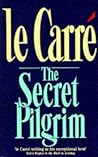
The Secret Pilgrim

The Secret PilgrimThe Secret Pilgrim by John le Carré
My rating: 4 of 5 stars

This book deviated quite a bit from le Carré's past Smiley novels. Told in the first person, this is actually a collection of anecdotes from one of Smiley's acolytes, Ned. Prompted by a speech Smiley gives to a group of new spies (taught by Ned), Ned reminisces about operations from the past, highlighting the human-ness of spies and the repercussions of that human-ness. I initially missed le Carrė's omniscient narrative and Smiley's perspective but the stories are interesting in and of themselves and while the whole book sort of ambles along (instead of building tension), it is still le Carré, and it is still a great spy read.

View all my reviews

Wednesday, August 3, 2022

As I Lay Dying

As I Lay DyingAs I Lay Dying by William Faulkner
My rating: 5 of 5 stars

I read this in high school and loved it. Rereading it at first I thought--why did I like this so much? But I think I had more patience in high school. After finishing it again, I went back and re-read certain chapters and yes, Faulkner takes a minute to get used to, but his ability to recreate the consciousness of all the different characters, add symbolism and forshadowing, tell a story in pieces and parts, was truly revolutionary and beautiful. I read somewhere it was like a Picasso painting--trying to show all the perspectives at once, which I thought was a lovely and apt way to describe it.

View all my reviews

Americanah


AmericanahAmericanah by Chimamanda Ngozi Adichie
My rating: 4 of 5 stars

Here's the thing: I've seen Chimamanda Ngoni Adichie give talks (on YouTube) and I love her. I didn't especially love the narrator of this book. I know they're obviously not the same but I was hoping to get more of the voice I admired from Adichie. This narrator is a bit too superior and condescending to garner a lot of my empathy. Anyway, it is definitely an interesting book. Its a book about Nigeria, but also about immigration. It's about the race issues in America (and England) and how recent immigrants are put in a unique position of having to navigate these issues without having shared in their history. (She tells a blurb about being expected to be offended by a watermelon comment, but being confused about why she should be offended). Its about returning to Nigeria and finding everything changed, especially her. It's a unique story and full of things to think about.

View all my reviews

How to Get Filthy Rich in Rising Asia

How to Get Filthy Rich in Rising AsiaHow to Get Filthy Rich in Rising Asia by Mohsin Hamid
My rating: 4 of 5 stars

A novel in the guise of a self-help book--could be gimmicky. A love story a la Love in the Time of Cholera--could be trite. But somehow the book transcends all that and enlightens us with business, government, and social aspects of "rising Asia".

View all my reviews


It can be borne endlessly, provided it is never acknowledged.

but like many desirable things, simply being well known does not make it easily achieved. 

(medical professionals).Their power to kill in the future by uttering mysterious words today robs her of her confidence and she, a customarily confident woman, resents this.  She longs to resist them but has no idea how to do so. 

But when you read a book, what you see are black squiggles on pulped wood or, increasingly, dark pixels on a pale screen.  To transform these icons into characters and events, you must imagine.  And when you imagine, you create.  It is in being read that a book becomes a book, and in each of a million different readings a book becomes one of a million different books, just as an egg becomes one of potentially a million different people when it's approached by a hard-swimming and frisky school of sperm. 

Friday, July 29, 2022

Tinker, Tailor, Soldier, Spy

Tinker Tailor Soldier Spy (George Smiley #5)Tinker Tailor Soldier Spy by John le Carré
My rating: 4 of 5 stars

Update: I've read this book now, like, three times, and I do think I finally caught all the little details. Well, most of them. I find it so interesting that le Carre's style varies from book to book. This title is definitely one of the densest, which is probably why it is so popular--so many layers building on each other. Here we are introduced to Karla, as a cold and calculating spy that George basically begs to defect in order to save,, but Karla simply steals George's lighter and goes to his fate which ends up not in the gulag but running a mole inside the Circus. Now George is called out of retirement to try and figure out which of George's friends and contemporaries it could be. Looking back, George sees how Karla used his weaknesses against him, so that the mole was able run under George's radar--and almost destroying the Circus in the process.

I really liked this book. I liked the cadance of the words le Carre uses, I liked the pondorous deliberateness with which the riddle unravels, I liked the humanity of the characters which blinded them to the answers when it was staring right at them. The villian Karla became that much more unlikeable as he twists the knife that he stuck in. I liked the secret language of the spies, (apparently this book introduces the word "mole" as a traitor into the vernacular)even though I sometimes didn't quite understand what was going on. In fact, I think it is a compliment to le Carre that I liked this book even though at the end, I was like, I think this is what happened.

View all my reviews

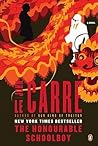
The Honorable Schoolboy

The Honourable Schoolboy (The Karla Trilogy, #2)The Honourable Schoolboy by John le Carré
My rating: 4 of 5 stars

Another reread. But reading it right after TTSS, I made more associations and the action in London seemed as relevant and interesting as the scenes of spying in the East. Le Carre's heroes don't always win the day, and this book illustrates how Smiley's obsession allowed him to lose the plot with his agent. It's as if, in this and TTSS, Smiley's ponderous research, his gift for connecting dots, his acute sense of where his quarry will go next somehow undermines his ability to see what is right in front of him. Perhaps it's no quirk that keeps Smiley's eyes half closed, or his habit of constantly cleaning his glasses with his tie--there surely is a bit of myopia about him.


I liked that le Carre writes an introduction to these editions of the Karla trilogy, because it helps me forgive the some of the distractions and ramblings in what is the most exciting but also weakest of the three. First of all, le Carre explains that he went on location to gather sights, sounds and experiences for this book, which explains the vividness and a lot of the action. It also explains why there are scenes in the book that, while interesting, don't move the plot forward. It's like he wanted to include an experience he had but didn't know where to put it.
Also, in the forward of Smiley's People, le Carre writes that he had anticipated doing a whole series of Smiley novels, which explains why neither Smiley nor Karla appear very prominently in this book. That being said, this was a great thrill ride with lots of mysterious persons, great loves, bombs, murders, thugs, and horse racing. Of the three, it is the most cinematic, yet it is the only one that didn't get made into a dramatization (yet).

View all my reviews

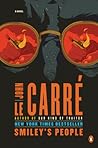
Smiley's People


Smiley's PeopleSmiley's People by John le Carré
My rating: 5 of 5 stars

Poor Smiley. Even when he wins he loses. In order to catch Karla, Smiley will have become almost as cold and calculating as Karla was when they first met, using Karla's one love against him as Karla once did to Smiley. So Smiley has finally won, but Smiley might wonder, won what?

It was so nice to get back to Smiley again...le Carre finished his Karla trilogy with an ode to Smiley. Here Smiley is at his best with his small, quiet thoughts and long walks, but gets thrown in the action, too as he tries to uncover the motive behind the murder of a former agent. Everyone gets their cameos, too, from Toby Esterhouse to dear old Connie. I could have used more Guilliam, though, who played a prominent part in The Honourable Schoolboy and who I kind of crushed on a bit (couldn't you see an English Peter Krause playing him?). The ending is strangely anti-climatic, but seemed entirely fitting: sometimes the ending is not nearly as much fun as the chase.

View all my reviews

Wednesday, June 29, 2022

Happy Families

 Chasing Apollo across a continent

We arrive at the city in night

Stalagmites glow at the heart

Christmas lights laid out beyond, blinking  it

Dawns on me they are porch lights

Peeping in and out through branches

Suburban home fires warming to the

American dream of couched laughter and 

Candlelit casseroles


Red lights scream along dark ribbons

White light feels anxiously ahead

An itching need to reach those strung out lights


All happy families are alike

warm baths   clean sheets

waltzes in stocking feet

every house the same beat

“How was your day, dear”

two steps right

Smashing, darling”

one step back

“You look lovely, doll”

left, left

blink, blink, *blush*

up


Up in the sky they are all just playthings

Lights flickering silent in the dark

Too far away to see dirt and grime,

Hear sobbing behind the radio,

See families lonely wreathed with webbed halos.


From here, I can hold the house in my palm

right, right, back

Put my eye up to the window

left, left, up

Before I shake it, and toss it away into the dark.


Friday, June 24, 2022

Chronicles of Narnia

The Chronicles of Narnia (Chronicles of Narnia, #1-7)The Chronicles of Narnia by C.S. Lewis
My rating: 4 of 5 stars

While The Lion, the Witch, and the Wardrobe is by far the best of the seven, they all add something to the tale. I remember being read Wardrobe when I was small and crying when Aslan was killed. Without it I don't think I would have been able to understand the sacrifice of Jesus Christ nearly as early in my life as I did. All of these books play a similar role: The Horse and His Boy illustrates how God uses trials to guide us and help us to grow. The Voyage of the Dawn Treader has the best allegory for repentance I've ever seen. There are illustrations of the importance of faith, the blessings of keeping the commandments with strict obedience, the danger of false gods, and the glory of the afterworld. Yes, Lewis' depiction of the Colormen are a bit discomfiting in this day and age and some of the "lessons" don't have the nuance that Wardrobe possess and comes off, therefore, as a bit too preachy. But overall these books are fun yet inspirational.

View all my reviews

The Looking Glass War

The Looking Glass WarThe Looking Glass War by John le Carré
My rating: 4 of 5 stars

The majority of this book deals with the training of an agent--only not done by the Circus (where Smiley is) but rather by the Department, which feels they have been undercut by the Circus. The Department remembers its glory days of the war and tries to recreate it by recruiting a former agent and retraining him with one of the old masters. Avery is new to the party and he is being trained as much as Leiser, the agent. Only the last third holds any real action, but it is a novel about the relationship of handler and agent--and agent and Department. It is cynical and heartbreaking. Smiley is not directly involved, so maybe he is excused from the amateur-ism and poor decisions of the Department, but the Circus knows full well what is going on and seems content to watch the Department implode with ineptitude.

View all my reviews

The Spy Who Came In from the Cold

The Spy Who Came In from the Cold (George Smiley #3)The Spy Who Came In from the Cold by John le Carré
My rating: 5 of 5 stars

One of le Carre's best books, mainly because of the ride that the reader takes with Leamas--we as readers are in the dark as much as he is, and when the whole story falls into place, we experience the same emotions. Smiley is in the background here, and far from being a hero, he is something of a puppet master with devastating results.


This is Le Carre's third book and the one where he hits his stride as the one of the best spy novelists. He said it this book came to him in three weeks and it shows: it is tight, full of suspense, and inspired. Loved it.

View all my reviews

A Murder of Quality

A Murder of Quality (George Smiley #2)A Murder of Quality by John le Carré
My rating: 3 of 5 stars

Here Smiley solves a murder, his circle of suspects include old friends from his spy days. The truth leads to places he'd rather not go, and so again there is no victory in the truth and the novel ends on a bleak, tired, lonely Smiley.

This is one Le Carre novel that is a straight up mystery and not a spy novel. It has lots of twists and turns and no one seems to be who you think...very well written. But I have to admit I missed the mystic of the spy genre.

View all my reviews

Call for the Dead

Call for the Dead (George Smiley #1)Call for the Dead by John le Carré
My rating: 3 of 5 stars

Yes, this may have been my third time reading this book. And it's not even le Carre's best work. But this time I focused on Smiley and realized that I'd been duped all along. Far from being a grandfatherly type, clever, lovable, and somehow being England's conscious, Smiley is simply a spy. Old and good--able to read the signs better than most, but also lonely, sad, given to fits of nostalgia and old anger. This novel ends with self-recrimination and regret and reading these novels in a row, there is a pervasive sadness.


This is Le Carre's first book, where we are introduced to George Smiley and Peter Guillium. Smiley is called to investigate a murder, and it is a decent murder mystery. It feels like Agatha Christie wrote a spy novel, but it is a good place to start with George. Unlike some of his later novels, Carre spells out the evidence and conclusions (almost painfully) so that the reader doesn't miss a thing. It was an enjoyable read and a good beginning for things to come.

View all my reviews

The Telling Room


The Telling Room: A Tale of Love, Betrayal, Revenge, and the World's Greatest Piece of CheeseThe Telling Room: A Tale of Love, Betrayal, Revenge, and the World's Greatest Piece of Cheese by Michael Paterniti
My rating: 4 of 5 stars

Starting out this seems like a pretentious memoir/non-fiction book about a piece of cheese. Sure, it has a great story, but I couldn't help eye-rolling as somehow Paterniti gets funding to actually live in Spain with his family, all the while learning to live in the moment, eat "slow" food, and "write". But this story morphs into so much more. There is a reason it is called The Telling Room and not say, Guzman's Cheese, and that is what makes this book transcendent and all the personal asides excusable and even necessary. This book is about the stories we get sucked into, the truths we find hard to let go of, the stories that we tell ourselves. Does knowing the truth make our stories more or less important? Does the truth diminish or add to our perceptions of people? In the end, the story was worth the listening.

View all my reviews

Tuesday, June 21, 2022

Submergence


SubmergenceSubmergence by J.M. Ledgard
My rating: 2 of 5 stars

I think it was the structure more than anything that made this book less enjoyable. Each passage is only a paragraph or so long--most not longer than a page--and they toggle between characters, musings, and time-lines. While I thought the love story was intriguing, it never really expands or develops it enough that it is believable that it somehow sustains James through a kidnapping by terrorists. There are interesting tidbits and an intriguing premise about life and death being submergences of sorts. There are warnings about global warming, and insights into jihadist fighters but the author didn't make me care enough to sit down and draw all the connections.

View all my reviews

For him, it was a very dark and specific place.


What will happen next? The failure of Marx’s vision has created the need for another vision, not for a rejection of all visions. What remains today is the idea of responsibility (when the nineteenth-century idea of progress has died out), which works against the loneliness and indifference of an individual living in the belly of a whale.

For example, at the Helsinki University of Technology’s low temperature lab, in 2001, a Bose-Einstein condensate cooled near to the absolute zero of minus 273 ° Celsius stopped dead a beam of light traveling at 978 million kilometers per hour.

Because in many ways the ocean is more hostile than space. Space flight is a journey outward. You can see where you are going, which is why the crews in spaceships generally sit in swivel chairs facing a giant window or screen. Space is about weightlessness and speeds never before achieved by machines and that can scarcely be felt; the discharge of aerosol is enough to propel a vessel forward, a nudge of a pencil sets its course, and all the while the air inside of it presses against the void outside. Ocean flight is, by contrast, a journey inward, toward blindness. It is about weight, the stopping of the craft on thermal layers, the pressure of water pushing in, and the discomfiting realization that most of the planet you call your own is hostile to you. There will never be a Neil Armstrong moment in the ocean. There is nothing to light the way, no prospect, no horizon; even encased in a metal suit the human body is too liquescent to contemplate stepping out onto the deep sea floor.