Thursday, March 11, 2021

The Hypnotist's Love Story


The Hypnotist's Love StoryThe Hypnotist's Love Story by Liane Moriarty
My rating: 4 of 5 stars

Moriarty does beach reads with a nice deep thoughtfulness to them. Disguised as a love story with a stalker, it explores all the ways we hold on to past relationships, and how that can hinder our current ones. Also, mourning is socially acceptable, but stalking is not, though there can be little difference.

View all my reviews

Wednesday, March 3, 2021

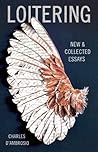
Loitering


Loitering: New & Collected EssaysLoitering: New & Collected Essays by Charles D'Ambrosio
My rating: 3 of 5 stars

I'm bumping this up to 3 stars, just because under all D'Ambrosio's pomp, there are nuggets of insight. I'm coming to find that a collection of essays can let you know more about an author than a memoir. These essays reveal a man who carries around a pretentious know-it-all under the guise of a Luddite who wears corduroy and is equally inept at camping. Mostly I think it is his vocabulary--which he more than critiques in others, so I feel is fair game. I constantly had to look up words, but when I did, they were "antiquated" or "uncommon", meaning--does he just read old 17th century books? Or maybe the trusty thesaurus was just too handy? He uses the conjunction "qua" in two of his essays. Seriously, who uses "qua"? If you can wade through the heavy-handed vocabulary, he does make some perceptive observations about history, grief, time, suicide, and literature. Also, the cover is very cool.

View all my reviews

in a sense we truly have history only insofar as it’s shared, and too much uniqueness really leads away from individuality to anonymity, the great sea of the forgotten.

I suppose it could also be said we’re known to the extent that we’re dull and orbital about our life, that what’s quotidian about us is more easily shared than the exuberances and passions that push us out of the predictable.

he’s mostly a misanthrope and a sentimentalist (how often those things go together!),

Randall Jarrell once wrote that even in the Golden Age people were always griping about how everything looked yellow; all our hopes elude us.

Just as shadows fall across lives, history falls across cultures. Things unravel never to reknit again

It’s always been a fond Western dream, after all the blood and pavement and franchising, to undo the whole sorry business and begin again.

“Relation is a mathematical notion which means one-to-one correspondence.”

Brick is relocated earth,

they wanted antiques without time.

Many of these gamblers were afraid of the past, haunted by it, and this tilted their faith in the direction of fate, a less ample, less accommodating idea.

As long as you could fall farther you distinguished yourself from the fallen.

anxiety has no object; in fact, it tries to become fear because fear has a definite object that can be faced with courage.

The absence of “real” money, flat money, is essentially the absence of a future. Not that the boys lack one—rather, possible futures never enter into their calculations; a cigarette equals pleasure, not the hoarding of deferred possibilities.

Is it size alone that accounts for the blurring of identity in a big family? The fact that you grow up crowded into the same bathroom, brushing your teeth in front of a mirror that has three or four other foamy white grins reflecting back at you—is that it?

suicide: that it’s always accompanied by some shift away from life’s normal priority, where it’s perfectly natural and expected that you’d defend yourself from danger, to a condition where you give up, defenseless, or even join in on the attack.

Is silence for a writer tantamount to suicide?

The belief in a single Truth leads to doubt about everything.

It is nonsense to say that God fills the gap; He doesn’t fill it, but on the contrary, He keeps it empty and so helps us to keep alive our former communion with each other, even at the cost of pain.

This seemed a crude and retrogressive project, since what really distinguishes us from apes is not the opposable thumb but the ability to hold in mind opposing ideas, a distinction we should probably try to preserve.

Whereas prison, well, what is it, really? A shortage of space compensated for by an excess of time.

This picture [of a man jumping/falling from the Twin Towers during 9/11] also brings us to a prison, one without a shortage of space; in fact, there’s a sudden, horrifying excess, a terrible liberation, with time in short supply.

If what distinguishes us from other members of the animal kingdom is speech, then literature—and poetry in particular, being the highest form of locution—is, to put it bluntly, the goal of our species.—Joseph Brodsky


A Spark of Light


A Spark of LightA Spark of Light by Jodi Picoult
My rating: 2 of 5 stars

I get that Picoult is trying to look at the issue of abortion from all different angles, and I think it is an important topic to consider from different lights, because it is a complicated issue. But I don't like the format of going backwards--it created a lot of repetition and some time line difficulties. Also, it was hard to remember how everything ended up for everybody by the end of the book. It diffused any sense of propulsion and I found it hard to motivate myself to keep reading. I also think there were too many characters. I get there are a lot of perspectives on this subject but the sheer number of characters kept us from really deep diving into any of them, and they all remained surface characters. Maybe that is why I didn't like any of these characters. I also felt that all anti-abortionists in this book were judgmental and absolute, while the pro-choice characters were willing to be understanding and tolerant. I think both sets of characteristics can be found in both sides. It's a good book to start a conversation and I thoroughly enjoyed the discussion in our book club, but as a book to just read, it didn't work for me.

View all my reviews

But there were those who believed if you do not name a thing, it ceases to exist, and so its title was amputated, like a war injury.

Were some betrayals kinder than others?

Did you have to be missed to exist?

A rush of calcium at the moment caused zinc to be released from the egg.  As the zinc burst out, it attached itself to small, fluorescent molecules: the spark that was picked up by camera microscopes.

Mischling


MischlingMischling by Affinity Konar
My rating: 4 of 5 stars

If a Danse Macabre could be written in words, this would be it. Telling the story of twin children and other genetic anomalies (dwarfism, albinism) that were sorted from concentration camps and used as experiments, this is far from an easy book to read. However, Konar uses such beautiful language and arresting images to portray these horrifics that at times you almost forget what she is describing. The tortures described are sometimes fantastic, and you can't help but wonder if they are based on fact--and then you realize that of course they are. The reunions and miracles that occur seem almost as fantastic, and easier to discount. But rather than discredit them, I chose to believe that if such atrocities could be real, so could these moments of hope. This story ends not with the liberation of Auschwitz, but goes on to describe the many months these refugees endured trying to find loved ones, and make their way to somewhere safe--a part that many stories leave out. Books of the holocaust are not easy to read, but I think we can learn from the strength of the sufferers and gain a determination to stop such cruelty wherever we find it.

View all my reviews

My letters were growing angry and their lack of signature was erasing me.  No one was counting bits of me in the laboratory anymore.  No one was totting up pieces of me.  I did not know if this was because the doctor told people not to or because the best part of me was gone.

Because I had it still, that wild hope; it was as steady as a spines and so pronounced I marveled. that the nurses and technicians did not take note of this development within me and mark it on their charts.

isn't evil a form of stupidity?

Those stars, they knew what suffering and renewal meant, they were forged from collapse and dust and fire.

the burden saved you, he finally said, until you had a moment to examine it, to feel, for once, its full weight.


Tuesday, March 2, 2021

dust

 Dust that fuzzes the edges

A great detritus fog

Made up of hair & skin & dandruff & powdered sweat & nubs from blue sweaters & sloughed mud from trainers worn when it rained & pollen from a mountain hike to Looking Glass Falls where ox-eyed daises rigidly rocked as if uprooting themselves to stalk after you--

Pieces of you attract and collect to your abandoned surfaces

As if it could proliferate thick enough to claim the matter as its own

As if you wanted to stay all along.


Those precocious motes dance

dizzy in the sun

like echos of your soul and 

trace the erratic trajectory of your 

travels in the shadows.


Let the dust nest in my brain

Let it choke my lungs

Let it mold its exoskeleton around me

Let all your pieces become my peace.

Friday, February 19, 2021

Long Bright River


Long Bright RiverLong Bright River by Liz Moore
My rating: 4 of 5 stars

Sold as a mystery, this is more of a study of sisterhood, one sister who happens to be drawn into a mystery because she is a patrol cop and is worried her missing sister may be the next serial killer's victim. The Philadelphia neighborhood where Mickey patrols and grew up in becomes the most important character. It is a study of how the working poor, beaten down and suspicious of those who keep them down, develop a pride of their own and can shame anyone trying to get out. Interestingly, it is more socially acceptable to "get out" by developing a drug habit than by pulling yourself up by your bootstraps. When drugs are so prevalent, there develops a new sort of equilibrium where the law tolerates some behaviors to concentrate on others. Where is that line? When drugs becomes so prevalent and accepted, how do you not get drawn in? How do you get out? Who's fault is it when you succumb? When does the law no longer become responsible for socially accepted behavior? what about family? Do you cut them off, take away rights, or just make sure they get clean needles? Obviously it raises a lot of interesting questions but I did not like the physical formatting of the book. I thought the lack of quotation marks added to the interiority of the novel (Is she speaking or thinking). But I'm still trying to figure out the reason for the breaks that follow every third paragraph or so. Wasn't a change of perspective, passing of time, or even new thought sometimes. Made the novel a bit choppy for me.

View all my reviews

This was the secret I learned that day: None of them want to be saved. They all want to sink backward toward the earth again, to be swallowed by the ground, to keep sleeping.  There is hatred on their faces when they are roused from the dead.

When, at bedtime, he falls asleep on me, I keep holding him.  Like I'm applying pressure to a wound.  Keeping the blood inside him.

Nicholas Nickleby


Nicholas NicklebyNicholas Nickleby by Charles Dickens
My rating: 3 of 5 stars

I finished a Dickens novel! Up to this pointed I have started several, but never finished one (not including A Christmas Carol ). Don't ask me why it would be Nickleby, which I found out afterwards is not one of his better novels. However, I did know it was written in serial form and I imagined what it would be like to wait in anticipation for the continuation of a story. Like the precursor of soap operas, I could see the draw in finding what happened to Nicholas, his sister, and the monstrous villain Uncle Ralph. Yes, it is sentimental, melodramatic, melancholic, and romantic but so are soap operas. It has a passable plot and some biting criticism on materialism and capitalism, but what really saves the day for me is Noggs, Ralph's s poorly used secretary, who quietly and sneakily unravels all of Ralph's nefarious plots against Nicholas. It possess the themes and motifs of Dickens from class disparity to child neglect and abuse, and comical characters.

View all my reviews

Mr. Squeers is the representative of a class, and not of an individual.

not being young enough or rich enough to aspire to the hand of a lady of fortune, had wedded an old flame out of mere attachment, who in her turn had taken him for the same reason. Thus two people who cannot afford to play cards for money, sometimes sit down to a quiet game for love.

for gold conjures up a mist about a man, more destructive of all his old senses and lulling to his feelings than the fumes of charcoal—

Spite is a little word; but it represents as strange a jumble of feelings, and compound of discords, as any polysyllable in the language.

A thief in fustian is a vulgar character, scarcely to be thought of by persons of refinement; but dress him in green velvet, with a high-crowned hat, and change the scene of his operations, from a thickly-peopled city, to a mountain road, and you shall find in him the very soul of poetry and adventure.

and in letters afflicted with every possible variation of spinal deformity,

Is selfishness a necessary ingredient in the composition of that passion called love, or does it deserve all the fine things which poets, in the exercise of their undoubted vocation, have said of it?

Pride is one of the seven deadly sins; but it cannot be the pride of a mother in her children, for that is a compound of two cardinal virtues—faith and hope.

He knew himself well, and choosing to imagine that all mankind were cast in the same mould, hated them; for, though no man hates himself, the coldest among us having too much self-love for that, yet most men unconsciously judge the world from themselves, and it will be very generally found that those who sneer habitually at human nature, and affect to despise it, are among its worst and least pleasant samples.

As the traveller sees farthest by day, and becomes aware of rugged mountains and trackless plains which the friendly darkness had shrouded from his sight and mind together, so, the wayfarer in the toilsome path of human life sees, with each returning sun, some new obstacle to surmount, some new height to be attained. Distances stretch out before him which, last night, were scarcely taken into account, and the light which gilds all nature with its cheerful beams, seems but to shine upon the weary obstacles that yet lie strewn between him and the grave.

When men are about to commit, or to sanction the commission of some injustice, it is not uncommon for them to express pity for the object either of that or some parallel proceeding, and to feel themselves, at the time, quite virtuous and moral, and immensely superior to those who express no pity at all. This is a kind of upholding of faith above works, and is very comfortable.